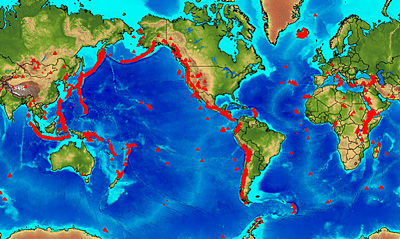
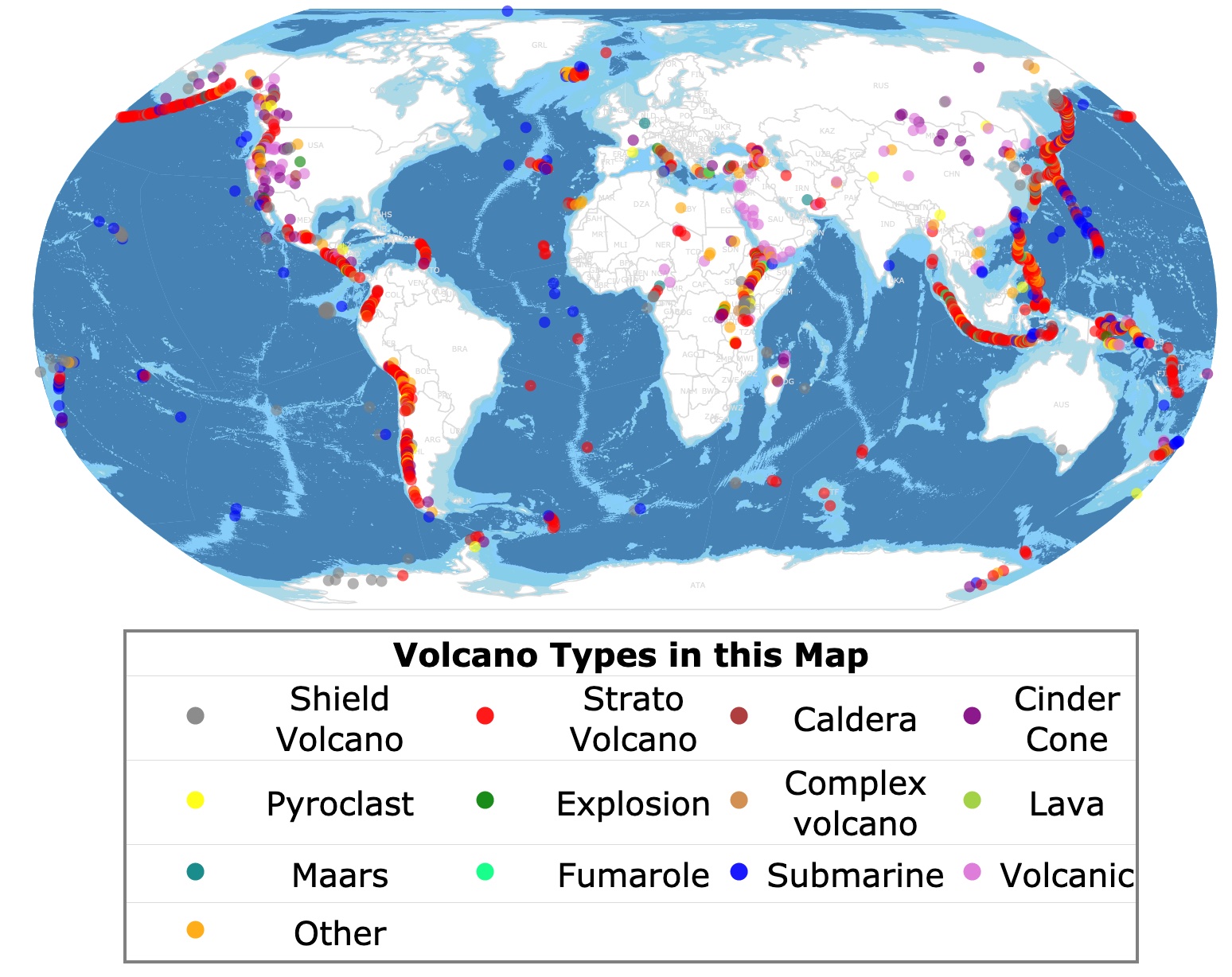
Understanding the global presence of volcanoes begins with recognizing that they are primarily found along the boundaries of Earth’s tectonic plates. These colossal, irregularly shaped slabs of solid rock float on a semi-fluid layer called the asthenosphere. As these plates interact – colliding, pulling apart, or sliding past each other – the conditions are created for magma, molten rock from deep within the Earth, to rise and erupt onto the surface, forming volcanoes.
The most prominent and active volcanic region on Earth is undoubtedly the Pacific Ring of Fire. This horseshoe-shaped belt stretches for approximately 40,000 kilometers (25,000 miles) around the Pacific Ocean basin. It’s responsible for about 90% of the world’s earthquakes and 75% of its active volcanoes.
Within the Ring of Fire, tectonic plates are constantly subducting, meaning one plate is diving beneath another. This process melts the rock in the overlying mantle, generating magma that rises to form volcanic arcs. Examples include the Andes Mountains in South America, the Cascade Range in North America, and the island arcs of Japan, the Philippines, and Indonesia.
Beyond the Ring of Fire, other significant volcanic zones exist. The Mid-Atlantic Ridge, a divergent plate boundary where the North American and Eurasian plates are pulling apart, is characterized by underwater volcanoes that form new oceanic crust. While less dramatic than their terrestrial counterparts, these volcanic processes are crucial for the Earth’s geological cycles.
Another major hotspot for volcanic activity is the Mediterranean region. Here, the African plate is colliding with the Eurasian plate, leading to volcanic activity in Italy (Mount Vesuvius, Mount Etna), Greece (Santorini), and other surrounding areas. These volcanoes are often explosive and have played a significant role in human history.
Intraplate volcanism, often referred to as ‘hotspot volcanism,’ provides another fascinating dimension to the global volcanic map. These volcanoes occur not at plate boundaries but over ‘hotspots’ – plumes of unusually hot mantle material rising from deep within the Earth. As a tectonic plate drifts over a stationary hotspot, a chain of volcanoes can form. The Hawaiian Islands are a classic example, with the youngest, most active volcano (Kilauea) situated directly over the hotspot.
The Hawaiian-Emperor seamount chain, stretching northwest from the Big Island, is a testament to this process. As the Pacific Plate moved, it carried the volcanoes away from the hotspot, rendering them extinct and forming a trail of submerged mountains and islands.
Africa also boasts notable volcanic features. The East African Rift Valley is a prime example of a divergent plate boundary on land, where the African continent is slowly splitting apart. This process has created a series of volcanoes, including Mount Kilimanjaro (dormant) and Mount Nyiragongo (active and known for its persistent lava lake).
Iceland, situated on the Mid-Atlantic Ridge, is a unique geological marvel. It’s one of the most volcanically active regions on Earth, experiencing frequent eruptions due to its location straddling the divergent plate boundary and a mantle plume beneath it. The island is literally being torn apart by tectonic forces, with volcanoes playing a key role in its formation and ongoing evolution.
When considering volcanoes on a world map, it’s important to differentiate between active, dormant, and extinct volcanoes. Active volcanoes are those that have erupted in recorded history and are expected to erupt again. Dormant volcanoes have not erupted recently but are considered likely to erupt in the future.
Extinct volcanoes, on the other hand, are not expected to erupt again. Their magma supply has been cut off, often due to changes in tectonic plate movement. However, classifying a volcano as extinct can be challenging, and sometimes, volcanoes thought to be extinct can surprise geologists with renewed activity.
The study of volcanoes, known as volcanology, provides invaluable insights into Earth’s internal processes. By analyzing volcanic rocks, gases, and eruption patterns, scientists can learn about the composition of the mantle, the dynamics of plate tectonics, and even the planet’s past climate.
Volcanic eruptions can have profound impacts on both the local environment and the global climate. While destructive in the short term, they also create fertile soils, form new land, and release gases that have influenced Earth’s atmosphere over geological timescales.
The distribution of volcanoes is a direct reflection of plate tectonics. The three main types of plate boundaries – convergent (subduction zones), divergent (spreading centers), and transform (strike-slip faults) – each influence volcanic activity differently.
Convergent boundaries, particularly subduction zones, are responsible for the most explosive and dangerous volcanoes. The melting of the subducting plate and the overlying mantle wedge generates silica-rich magma, which tends to be more viscous and prone to trapping gases, leading to violent eruptions.
Divergent boundaries, like the Mid-Atlantic Ridge, typically produce less explosive eruptions. Here, plates pull apart, allowing magma to rise and fill the gap. This magma is usually basaltic, less viscous, and erupts more effusively, forming shield volcanoes and mid-ocean ridges.
The ‘People Also Ask’ section often highlights common curiosities about volcanoes. Questions like ‘Where are most of the world’s active volcanoes located?’ are directly answered by the prominence of the Ring of Fire. Another common query might be ‘What is the most dangerous volcano in the world?’ While ‘most dangerous’ is subjective and depends on factors like proximity to populated areas and eruption style, volcanoes like Vesuvius, Krakatoa, and Mount Rainier are often cited due to their potential for catastrophic eruptions.
Understanding the ‘why’ behind volcanic locations requires grasping the concept of magma generation. At subduction zones, water released from the descending plate lowers the melting point of the overlying mantle. At divergent boundaries, decompression melting occurs as the plates pull apart, reducing pressure and allowing rock to melt. Hotspots involve mantle plumes that are inherently hotter than the surrounding mantle.
The world map of volcanoes is a dynamic canvas. Continents drift, plate boundaries evolve, and new volcanoes can form while others become dormant or extinct over geological time. This constant geological reshaping underscores the living nature of our planet.
The sheer number of volcanoes is staggering. Estimates suggest there are over 1,500 potentially active volcanoes on land today, with many more beneath the oceans. These geological giants are a constant reminder of the powerful forces at play beneath our feet.
From the towering stratovolcanoes of the Andes to the shield volcanoes of Hawaii and the fissure eruptions of Iceland, the variety of volcanic landforms is immense. Each type is shaped by the composition of the magma, the style of eruption, and the underlying tectonic setting.
The impact of volcanic ash on aviation is a significant modern concern. Eruptions can release vast clouds of fine ash particles that can damage aircraft engines, leading to flight cancellations and disruptions, particularly in regions like Iceland and Indonesia.
Looking at a world map and pinpointing volcanoes offers a visual lesson in geology. It highlights areas of intense geological activity and connects these phenomena to the larger framework of plate tectonics. It’s a map not just of mountains, but of Earth’s internal engine at work.
The Pacific Ring of Fire, as previously mentioned, is the most concentrated area. Countries like the United States (Alaska, Hawaii, Pacific Northwest), Japan, Indonesia, the Philippines, and Chile lie within this volatile zone.
Other significant volcanic areas include: Europe (Italy, Iceland, Greece), Africa (East African Rift Valley), and scattered islands across the globe.
The geological processes that create volcanoes are fundamental to Earth’s evolution. They contribute to the formation of new crust, the recycling of materials, and the release of gases that have shaped our atmosphere and climate over billions of years.
In conclusion, the distribution of volcanoes on a world map is a clear indicator of tectonic plate boundaries and mantle hotspots. The Ring of Fire dominates the global landscape of volcanic activity, but significant volcanic regions are found across continents and beneath the oceans, each telling a story of Earth’s dynamic geological history.
These natural wonders, while posing risks, are also creators of land, fertile soils, and unique ecosystems. Studying their patterns on the world map allows us to better understand our planet’s past, present, and future.
The ongoing study of volcanology continues to refine our understanding of these powerful forces, improving our ability to predict eruptions and mitigate their impacts, ensuring that our knowledge of these geological spectacles keeps pace with their ever-present potential.