For centuries, scholars, artists, and readers alike have sought to ‘map Dante’s Inferno,’ to visualize the intricate layers of damnation and the precise nature of justice meted out to the damned. This article serves as your comprehensive guide, journeying through each circle, detailing its inhabitants, their transgressions, and the ingenious, often terrifying, contrapasso (poetic justice) that defines their eternal suffering.
The journey begins on the night of Good Friday in the year 1300, as Dante, lost in a dark wood, is rescued by the spirit of the Roman poet Virgil. Virgil becomes Dante’s guide through the underworld, leading him down through the various circles of Hell, each designed to punish sins with increasing severity as they descend deeper towards the Earth’s center.
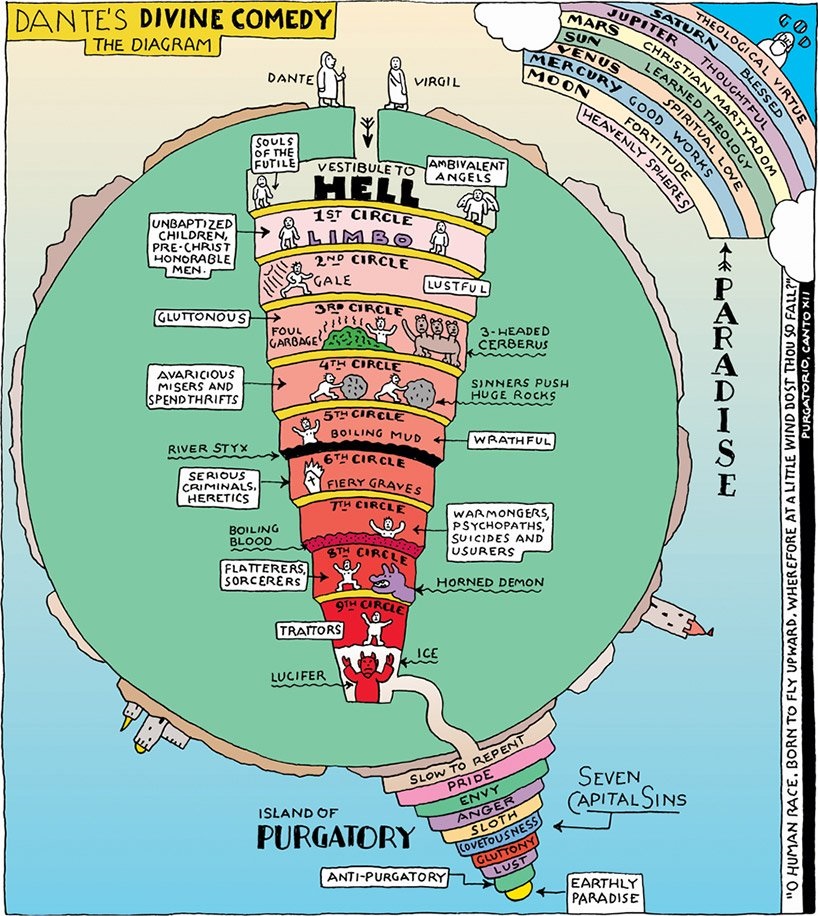
Dante’s Hell is not merely a place of suffering; it is a moral universe, a reflection of medieval Christian theology and philosophy. The structure of Hell itself, a funnel-shaped abyss, directly correlates with the perceived gravity of sin, moving from lesser sins of incontinence at the top to the most grievous sins of treachery at the very bottom.
Before reaching the formal circles of Hell, Dante and Virgil traverse the Vestibule of the Indifferent. Here dwell the souls of those who lived without praise or blame, never choosing good or evil. Their punishment is to chase a meaningless banner forever, stung by wasps and hornets, their tears and blood feeding repulsive worms. They are neither in Hell nor out, rejected by both Heaven and Hell.
The official entry to Hell is through the gate inscribed with the chilling words: ‘Abandon all hope, ye who enter here.’ Beyond this gate lies the first true circle.
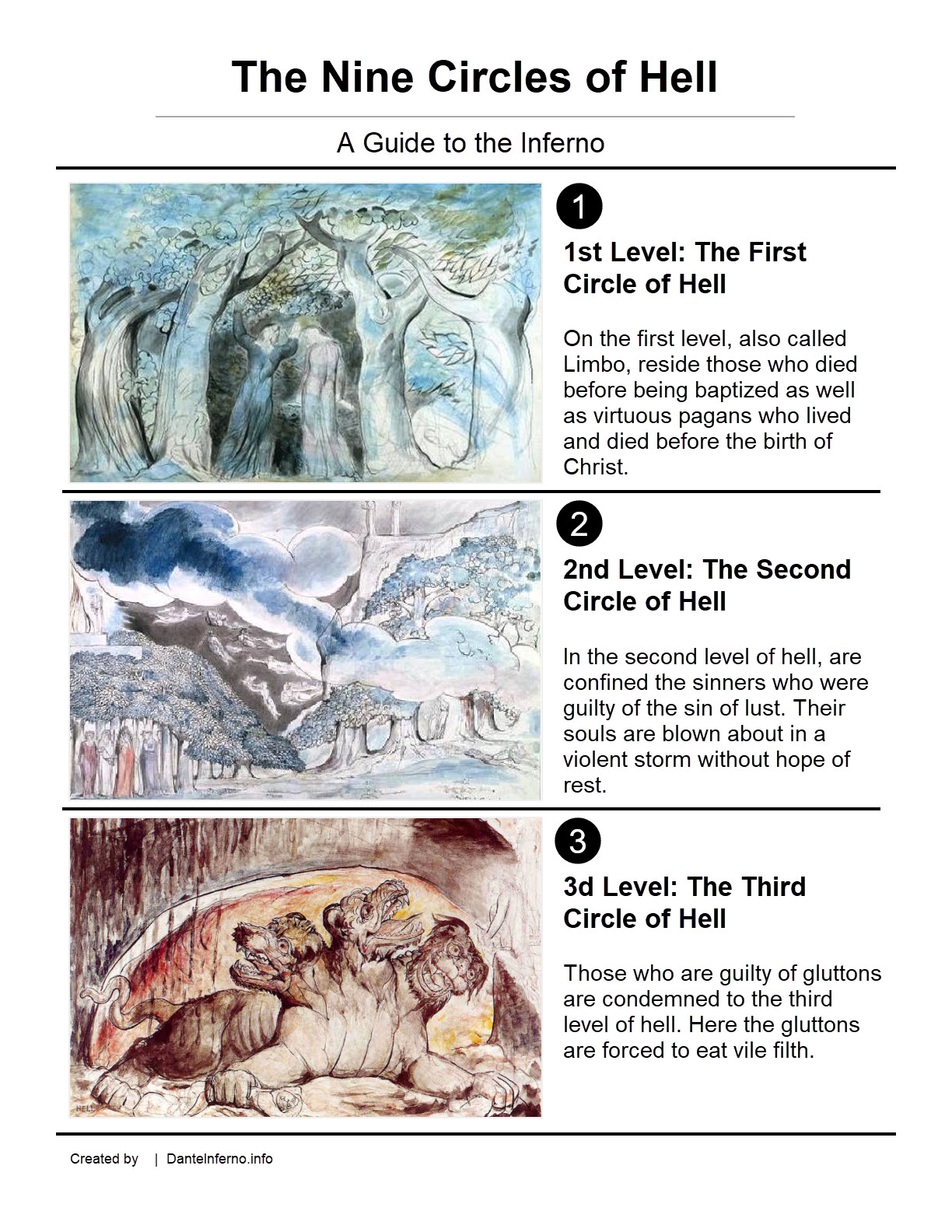
The First Circle: Limbo (The Virtuous Pagans)
Beyond the Acheron river, guarded by Charon, lies Limbo. This is the dwelling place of the unbaptized and virtuous pagans – great philosophers, poets, and heroes who lived before Christ or without knowledge of God. They suffer no physical torment but live in perpetual longing, without hope of salvation. Figures like Homer, Horace, Ovid, and Virgil himself reside here, experiencing a quiet sorrow.
Upper Hell: The Sins of Incontinence
The next four circles punish those who sinned through a lack of self-control or moderation. These are considered lesser sins because they stem from a failure to restrain natural appetites rather than malicious intent.
The Second Circle: Lust
Guarded by the monstrous Minos, who judges each soul and wraps his tail around himself to indicate the circle to which they are damned, this circle is reserved for the lustful. They are continuously swept about in a violent, never-ending whirlwind, symbolizing their uncontrolled passions in life. Here, Dante encounters famous lovers like Francesca da Rimini and Paolo Malatesta, Cleopatra, Helen of Troy, and Achilles.
The Third Circle: Gluttony
Here, the gluttonous lie prostrate in a vile, freezing slush, battered by a continuous storm of putrid rain, hail, and snow. Cerberus, the three-headed dog, guards them, tearing and barking. Their punishment reflects their indulgence in earthly pleasures, reducing them to mere swill in life and death.
The Fourth Circle: Avarice and Prodigality
The avaricious (hoarders) and the prodigal (wasters) are condemned to push massive weights against each other in a ceaseless, futile struggle. They shout insults at one another, condemning the opposite vice. Their endless, pointless labor symbolizes their obsession with wealth, either hoarding it or squandering it without purpose.
The Fifth Circle: Wrath and Sullenness
This circle is located in the swampy river Styx. The wrathful continually fight and tear at each other on the surface of the putrid water, while the sullen lie submerged beneath the muck, gurgling in their silent rage and resentment. Phlegyas, the mythological ferryman, transports Dante and Virgil across the Styx.
The City of Dis and Lower Hell
The journey then leads to the formidable walls of the City of Dis, marking the division between Upper and Lower Hell. This transition signifies a shift from sins of incontinence to more severe sins of malice, violence, and fraud. Inside Dis, the landscape becomes darker, more infernal, guarded by fallen angels and the Furies.
The Sixth Circle: Heresy
Within the City of Dis, heretics are entombed in fiery sepulchers, their eternal resting place a burning coffin. Their punishment mirrors their denial of God and immortality, as they believed the soul died with the body. Farinata degli Uberti and Cavalcante de’ Cavalcanti are notable figures encountered here.
The Seventh Circle: Violence
Guarded by the Minotaur, the Seventh Circle is divided into three rings, punishing different forms of violence.
- Outer Ring: Violence Against Neighbors: Tyrants and murderers are immersed in the Phlegethon, a river of boiling blood, supervised by centaurs who shoot arrows at any who try to rise above their allotted depth.
- Middle Ring: Violence Against Self: Suicides are transformed into gnarled, thorny trees, their leaves eaten by Harpies. Spendthrifts, who violently destroyed their own property, are chased and torn apart by savage black hounds.
- Inner Ring: Violence Against God, Nature, and Art: This ring holds blasphemers (lying supine on burning sand), sodomites (wandering endlessly under a rain of fire), and usurers (crouching beneath the fiery rain, their purses around their necks).
The Eighth Circle: Fraud (Malebolge)
The Eighth Circle, known as Malebolge (‘evil pouches’), is a vast, rocky amphitheater divided into ten concentric ditches (bolge), each punishing a specific type of ordinary fraud. Dante and Virgil are carried across the abyss by the monster Geryon, a creature symbolizing fraud with its human face, scaly body, and scorpion’s tail.
- Bolgia 1: Panderers and Seducers: Driven by horned demons, they march in opposite directions, eternally lashed.
- Bolgia 2: Flatterers: Immersed in human excrement.
- Bolgia 3: Simoniacs: Buried headfirst in rock, with flames burning their feet, symbolizing their inverted spiritual values.
- Bolgia 4: Sorcerers and False Prophets: Their heads are twisted backward on their bodies, forcing them to walk eternally with tears streaming down their backs.
- Bolgia 5: Corrupt Officials (Barrators): Immersed in a pit of boiling pitch, guarded by demons called Malebranche.
- Bolgia 6: Hypocrites: Wear heavy, gilded lead cloaks, forced to walk slowly.
- Bolgia 7: Thieves: Attacked and transformed by venomous serpents, constantly stealing back their human form.
- Bolgia 8: Deceivers (Evil Counselors): Encased in individual flames, their words of deceit now their eternal prison.
- Bolgia 9: Sowers of Discord: Repeatedly mutilated by a demon with a sword, their bodies healing only to be torn apart again.
- Bolgia 10: Falsifiers: Afflicted with various diseases, including leprosy, dropsy, and fever, reflecting their corruption of reality.
The Ninth Circle: Treachery (Cocytus)
The deepest and most grievous circle, Cocytus, is a frozen lake where the treacherous are eternally encased in ice, varying in depth depending on the severity of their betrayal. This circle is divided into four concentric rounds.
- Caina: Treachery Against Kin: Buried up to their chins in ice, named after Cain.
- Antenora: Treachery Against Country: Buried up to their necks, named after Antenor of Troy.
- Ptolomea: Treachery Against Guests: Buried face-up, their tears freezing their eyes shut, named after Ptolemy, who murdered his guests.
- Judecca: Treachery Against Benefactors: Completely submerged in ice, distorted into grotesque positions, named after Judas Iscariot.
At the very center of Judecca, and indeed at the center of the Earth, is Lucifer (Dis), the ultimate betrayer. He is depicted as a monstrous, three-headed giant, eternally chewing on the three greatest traitors in history: Judas Iscariot (who betrayed Christ), Brutus, and Cassius (who betrayed Julius Caesar). His constant flapping wings create the icy wind that freezes Cocytus, trapping him and all the damned.
The journey through Dante’s Inferno is not merely a catalogue of horrors; it is a profound allegorical exploration of sin, justice, and redemption. Each circle, each punishment, is a carefully crafted symbol, designed to reveal the true nature and consequences of human transgression. The physical descent through Hell mirrors a spiritual descent into the depths of depravity, challenging the reader to reflect on their own moral compass.
Dante’s map of Hell is also a remarkable testament to medieval cosmology and moral philosophy. The geocentric model of the universe was prevalent, and Dante ingeniously integrated this understanding with Christian theology, creating a coherent and terrifying vision of divine justice. The precise ordering of sins reflects the scholastic hierarchy of vice, moving from lesser sins of appetite to the graver sins of malice and fraud, culminating in the ultimate sin of treachery.
Common Questions About Dante’s Inferno’s Geography
Many readers often wonder about the practicalities of navigating this infernal landscape.
How is Dante’s Inferno structured?
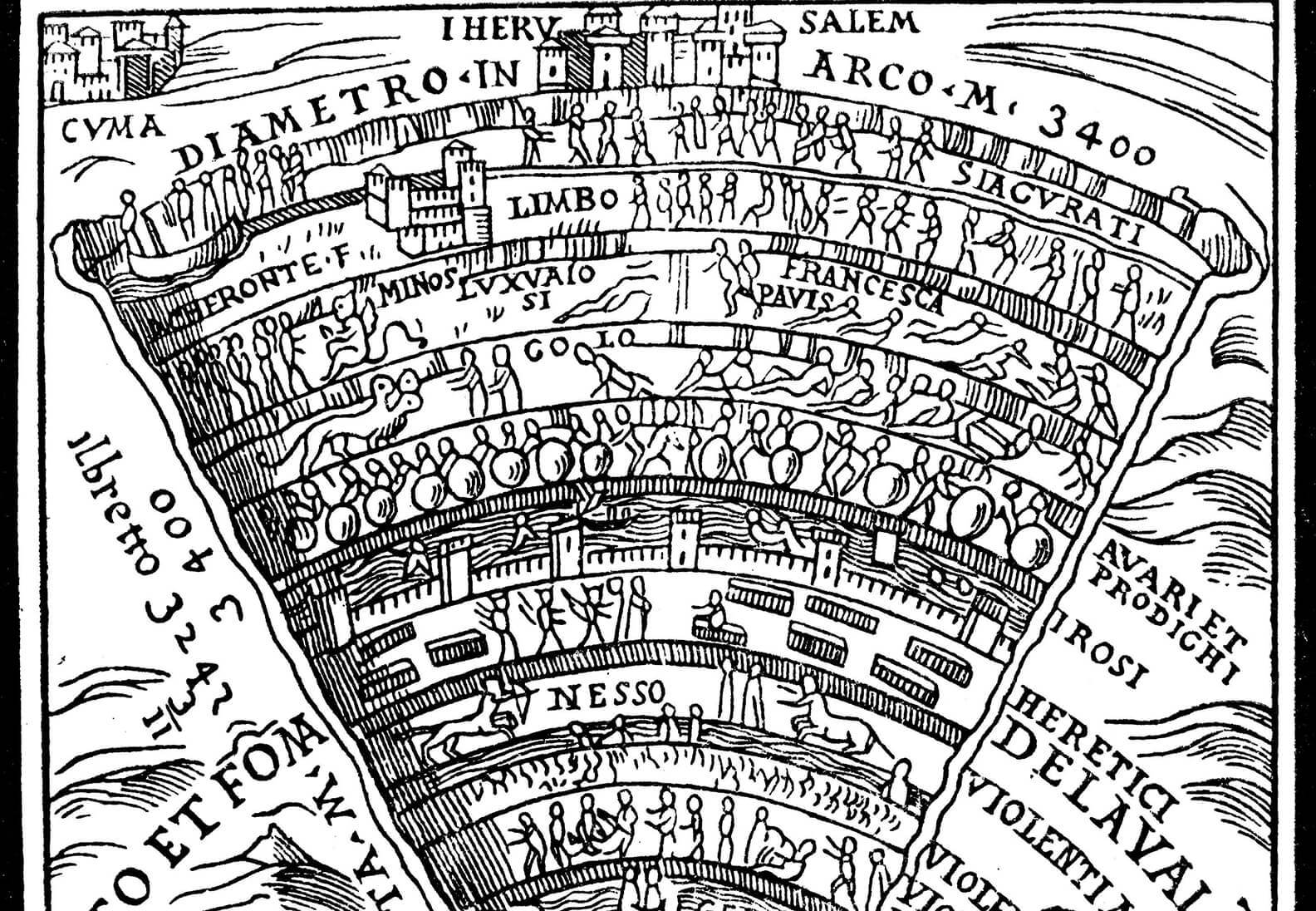
Dante’s Inferno is structured as a vast, funnel-shaped pit descending into the Earth. It begins with a Vestibule for the Indifferent, followed by nine concentric circles, each narrower and deeper than the last. These circles are broadly categorized into Upper Hell (sins of incontinence) and Lower Hell (sins of malice, violence, and fraud), separated by the fortified City of Dis.
What are the 9 circles of Hell in order?
The nine circles of Hell, in order of descent, are:
- 1. Limbo (Virtuous Pagans)
- 2. Lust
- 3. Gluttony
- 4. Avarice and Prodigality
- 5. Wrath and Sullenness
- 6. Heresy
- 7. Violence (against neighbors, self, God/nature/art)
- 8. Fraud (Malebolge – 10 ditches)
- 9. Treachery (Cocytus – 4 rounds)
Who guides Dante through Hell?
Dante is primarily guided through Hell by the spirit of the Roman epic poet Virgil. Virgil symbolizes human reason and classical wisdom, capable of guiding one through the moral complexities of sin, but unable to enter Paradise himself due to his paganism.
Is there an official map of Dante’s Inferno?
While Dante himself did not draw a literal map, his meticulous descriptions have inspired countless artists and scholars throughout history to create visual representations. These ‘maps’ are interpretations based on his detailed text, aiming to capture the spatial relationships and symbolic topography of his Hell. Famous interpretations include those by Sandro Botticelli and Gustave Doré.
The journey through Dante’s Inferno concludes as Dante and Virgil climb down Lucifer’s hairy flank, passing through the center of the Earth and emerging on the other side, eventually reaching the base of Mount Purgatory. This arduous ascent symbolizes the soul’s arduous path from sin to repentance and eventual redemption.
Mapping Dante’s Inferno is more than a literary exercise; it’s an exploration of human nature, morality, and the consequences of our choices. Dante’s vision remains a powerful and enduring testament to the human imagination, offering a profound reflection on justice, suffering, and the eternal struggle between good and evil.
In conclusion, Dante Alighieri crafted a masterpiece whose structural integrity is as compelling as its poetic verse. The intricate ‘map’ of Hell, with its nine distinct circles, serves not only as a geographical guide but as a moral compass, illustrating the escalating severity of sin and the precise nature of divine retribution. From the mild sorrow of Limbo to the frozen depths of treachery, Dante’s Inferno continues to captivate and challenge readers, inviting them to reflect on their own journey through life and the choices that define it.