This comprehensive guide will navigate the entire NFL divisional landscape, breaking down each of the league’s eight divisions. We’ll delve into the teams that comprise them, touch upon their unique characteristics, and explain why this divisional setup is crucial to the very fabric of American football. Whether you’re a seasoned enthusiast or a new fan, this exploration will enhance your appreciation for the strategic genius behind the NFL’s structure.
Understanding the NFL’s Core Structure: Conferences and Divisions
Before diving into the individual divisions, it’s essential to grasp the overarching framework of the NFL. The league is bifurcated into two conferences: the American Football Conference (AFC) and the National Football Conference (NFC). Each conference consists of 16 teams, totaling 32 teams across the entire league. This two-conference system dates back to the 1970 merger of the NFL and the American Football League (AFL).
Within each of these conferences, teams are further grouped into four divisions, typically based on geographical proximity. This means the AFC has four divisions (East, North, South, West) and the NFC also has four divisions (East, North, South, West). This divisional alignment is not merely for organizational purposes; it profoundly impacts scheduling, rivalries, and the path to the postseason.
The American Football Conference (AFC) Divisions
The AFC is home to many of the league’s most storied franchises and intense rivalries. Let’s explore its four distinct divisions, examining the teams and their competitive landscapes.
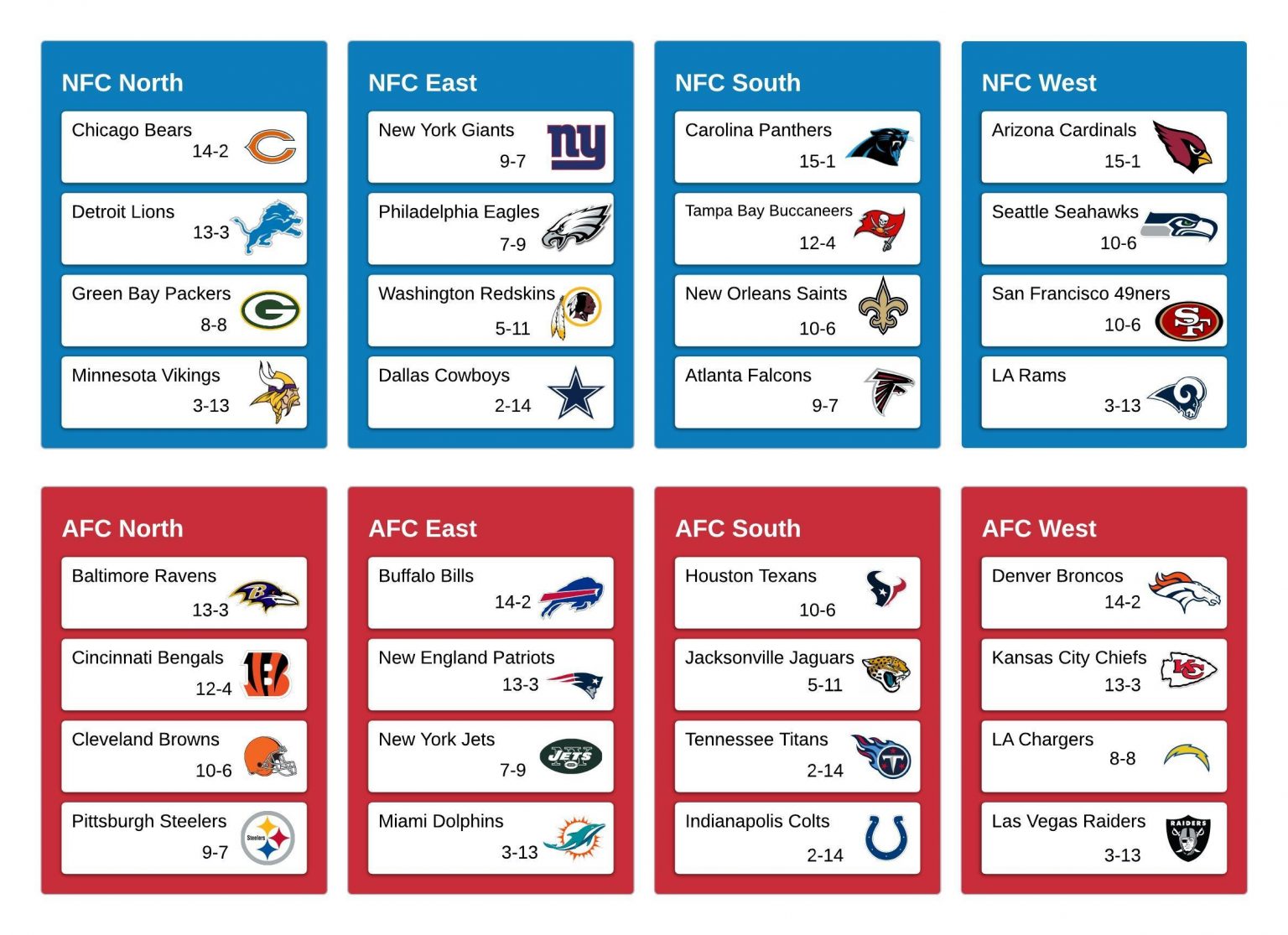
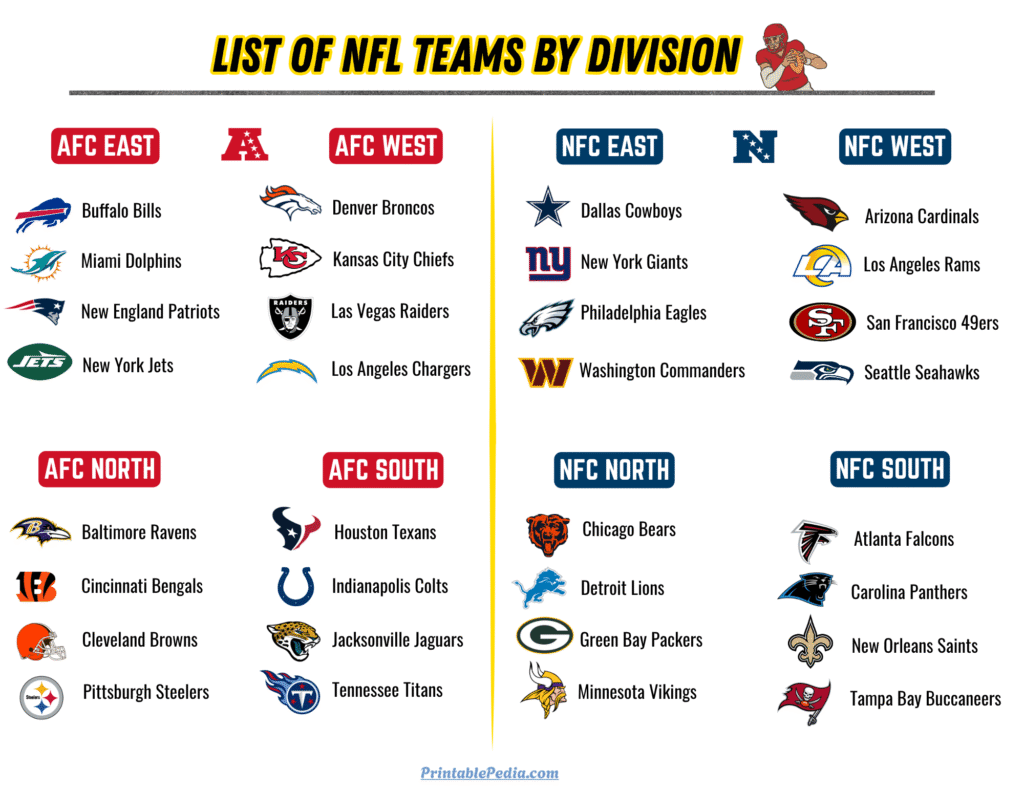
AFC East: A Look at the Teams The AFC East is one of the NFL’s most recognized divisions, historically dominated by the New England Patriots for two decades. Its current members include the Buffalo Bills, Miami Dolphins, New England Patriots, and New York Jets. This division is known for its cold-weather games and passionate fan bases.
Key Teams and Dynamics:
- Buffalo Bills: Resurgent in recent years, known for their loyal ‘Bills Mafia’ fanbase.
- Miami Dolphins: Often vying for supremacy, with a rich history of success.
- New England Patriots: A dynasty under Tom Brady and Bill Belichick, now in a rebuilding phase.
- New York Jets: Continuously seeking to climb back to divisional and league prominence.
AFC North: The Gritty Football Heartlands The AFC North is renowned for its hard-nosed, physical brand of football. Comprising the Baltimore Ravens, Cincinnati Bengals, Cleveland Browns, and Pittsburgh Steelers, this division is a crucible of intense rivalries and defensive prowess.
Key Teams and Dynamics:
- Baltimore Ravens: Built on strong defenses and a powerful running game.
- Cincinnati Bengals: A recent Super Bowl contender, known for explosive offensive talent.
- Cleveland Browns: A storied franchise with a dedicated fanbase, always a tough out.
- Pittsburgh Steelers: One of the NFL’s most successful franchises, defined by toughness and tradition.
AFC South: A Developing Landscape The AFC South features teams from the warmer southern states, and while it might not always garner the same historical fanfare as others, it’s consistently competitive. Its teams are the Houston Texans, Indianapolis Colts, Jacksonville Jaguars, and Tennessee Titans.
Key Teams and Dynamics:
- Houston Texans: A relatively newer franchise, often showcasing dynamic talent.
- Indianapolis Colts: Known for their quarterback play and consistent competitiveness.
- Jacksonville Jaguars: A team with a loyal following, often featuring exciting young talent.
- Tennessee Titans: Built on a strong running game and physical play.
AFC West: The Speed and Splash Division The AFC West is home to some of the league’s most explosive offenses and storied rivalries. This division includes the Denver Broncos, Kansas City Chiefs, Las Vegas Raiders, and Los Angeles Chargers, spanning a wide geographical area.
Key Teams and Dynamics:
- Denver Broncos: A franchise with a proud history of Super Bowl victories.
- Kansas City Chiefs: A dominant force in recent years, led by a generational quarterback.
- Las Vegas Raiders: A historic franchise with a passionate, nomadic fanbase.
- Los Angeles Chargers: Known for their high-flying passing attacks and dynamic players.
The National Football Conference (NFC) Divisions
The NFC, like its AFC counterpart, is rich with history, iconic teams, and passionate fan bases. Let’s explore its four divisions.
NFC East: The ‘Black and Blue’ Division Often dubbed the ‘Black and Blue’ division for its physical play and intense rivalries, the NFC East is one of the most followed in the league. It features the Dallas Cowboys, New York Giants, Philadelphia Eagles, and Washington Commanders.
Key Teams and Dynamics:
- Dallas Cowboys: ‘America’s Team,’ with a massive national following and high expectations.
- New York Giants: A historic franchise with multiple Super Bowl titles.
- Philadelphia Eagles: Known for their passionate fanbase and aggressive play.
- Washington Commanders: A team with a rich history, aiming for future success.
NFC North: Frozen Tundras and Storied Franchises The NFC North is defined by its cold-weather cities and some of the NFL’s oldest and most iconic franchises. The Chicago Bears, Detroit Lions, Green Bay Packers, and Minnesota Vikings make up this division.
Key Teams and Dynamics:
- Chicago Bears: A foundational NFL franchise, known for its defensive legacy.
- Detroit Lions: A team with a dedicated fanbase, building towards sustained success.
- Green Bay Packers: The only publicly owned team, with a legendary history and Lambeau Field.
- Minnesota Vikings: Often contenders, known for their high-powered offenses.
NFC South: The Sunshine and Shootouts Division The NFC South is known for its warm climates and often high-scoring affairs. This division includes the Atlanta Falcons, Carolina Panthers, New Orleans Saints, and Tampa Bay Buccaneers.
Key Teams and Dynamics:
- Atlanta Falcons: A high-flying offense often characterizes this team.
- Carolina Panthers: Known for their strong defenses and dual-threat quarterbacks.
- New Orleans Saints: A team with a passionate fanbase and a history of offensive fireworks.
- Tampa Bay Buccaneers: Recent Super Bowl winners, attracting top-tier talent.
NFC West: The West Coast Powerhouses The NFC West has emerged as one of the league’s most competitive divisions, featuring innovative offenses and stout defenses. Its members are the Arizona Cardinals, Los Angeles Rams, San Francisco 49ers, and Seattle Seahawks.
Key Teams and Dynamics:
- Arizona Cardinals: Often featuring dynamic offensive players.
- Los Angeles Rams: A recent Super Bowl champion, known for star power.
- San Francisco 49ers: A storied franchise with a physical, run-heavy scheme.
- Seattle Seahawks: Known for their ’12th Man’ fanbase and strong defensive play.
Why NFL Divisions Matter: Beyond Just Geography
- Scheduling: Each team plays its three divisional opponents twice a season (home and away), accounting for six of their seventeen regular-season games. This ensures intense, familiar matchups.
- Rivalries: Playing divisional opponents twice a year naturally fosters deep-seated rivalries, often leading to some of the most anticipated and hard-fought games on the schedule.
- Playoff Qualification: The winner of each of the eight divisions automatically secures a playoff berth. This means that a team can have a worse overall record than a non-divisional winner but still make the playoffs by winning their division.
- Home-Field Advantage: Divisional winners often earn higher seeds in the playoffs, granting them the crucial advantage of playing at home in front of their fans.
- Competitive Balance: While not always perfect, the division structure aims to create regional balance and ensures that teams frequently test themselves against familiar foes, adding a layer of strategy to roster building.
Common Questions About NFL Divisions (People Also Ask)
Fans often have specific queries regarding the structure and dynamics of NFL divisions. Let’s address some of the most common ones.
How many NFL divisions are there? There are eight NFL divisions in total. The league is divided into two conferences, the AFC and the NFC, and each conference contains four divisions.
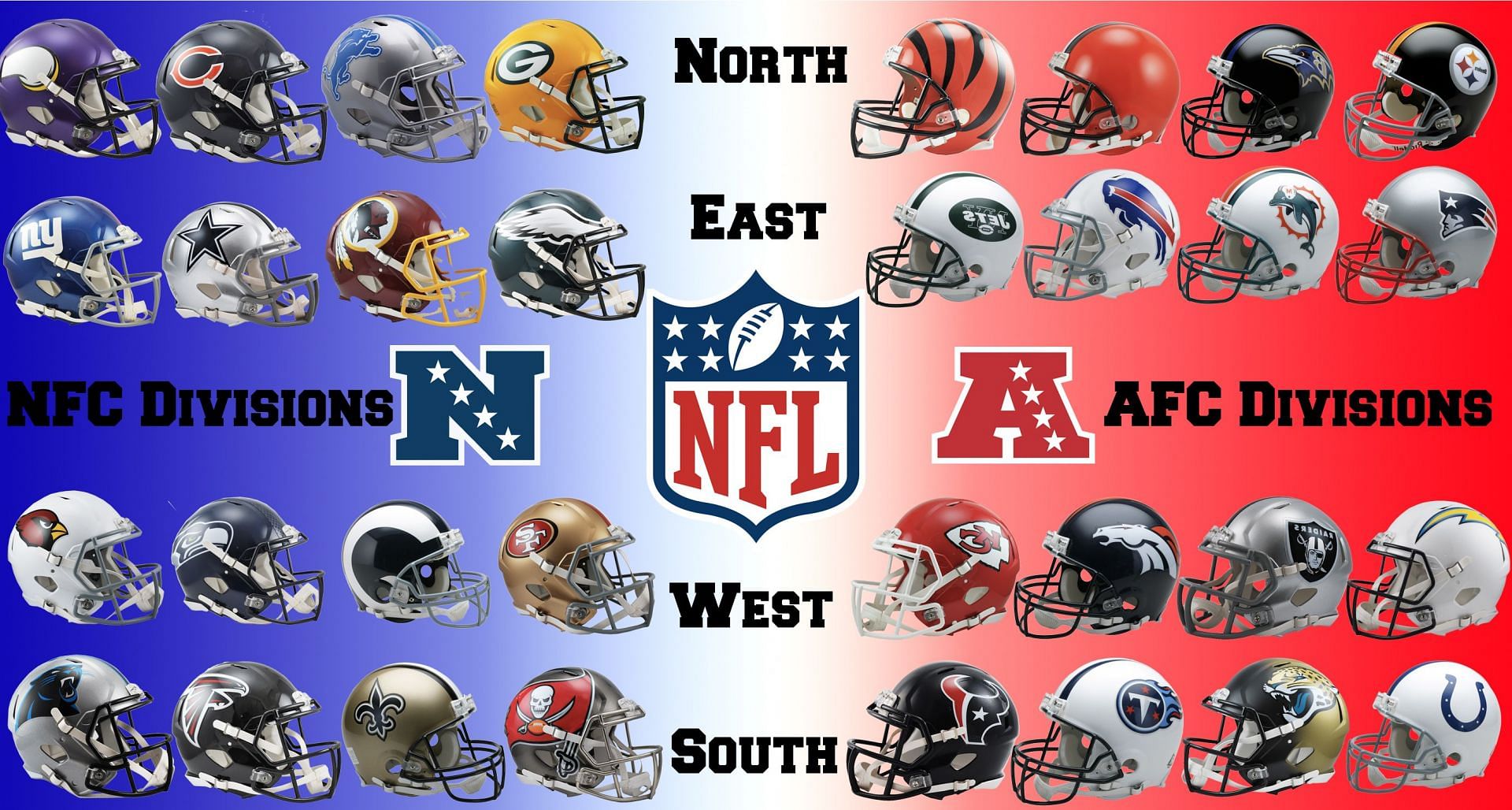
What are the 8 NFL divisions? The eight divisions are: AFC East, AFC North, AFC South, AFC West, NFC East, NFC North, NFC South, and NFC West.
How are NFL divisions decided? Divisions were primarily decided based on geographical location when the current structure was established following the 1970 AFL-NFL merger and subsequent realignments (most notably in 2002 with the addition of the Houston Texans). The goal is to group teams that are relatively close to each other to minimize travel and foster regional rivalries.
Do NFL divisions ever change? While the current 8-division, 32-team structure has been stable since 2002, divisions can change. Realignment typically occurs when the league expands by adding new teams or if there’s a significant geographical relocation of an existing franchise. Historically, divisional alignments have shifted multiple times throughout the NFL’s existence.
What is the purpose of NFL divisions? The primary purposes are to organize the league into manageable competitive units, facilitate scheduling, cultivate intense regional rivalries, and provide a clear pathway for teams to qualify for the postseason playoffs (with each division winner earning an automatic berth).
What is the hardest NFL division? Similar to the ‘easiest’ question, the ‘hardest’ division is subjective and dynamic. Divisions like the AFC North or NFC West have often been cited for their consistent strength and multiple playoff contenders, but this status is never permanent. The strength of schedule within a division varies greatly year to year.
The Evolution of NFL Divisional Alignment
The NFL’s divisional structure hasn’t always been as it is today. Prior to the 1970 merger, both the NFL and AFL had their own divisional setups. The merger created the current AFC and NFC, and subsequent expansions and team relocations (like the Browns moving to Baltimore to become the Ravens, and the new Browns franchise being created) led to realignments. The most recent significant realignment occurred in 2002 with the addition of the Houston Texans, establishing the current 32-team, 8-division format.
These historical shifts underscore the league’s adaptability and commitment to maintaining competitive balance and geographical sense, even as the sport grows and franchises evolve. Each realignment decision is a complex process, balancing tradition, logistics, and competitive fairness.
Conclusion: The Enduring Importance of the NFL Divisions Map
The NFL divisions map is far more than a simple geographical breakdown; it’s a living blueprint that shapes the league’s narrative, fuels its rivalries, and dictates the path to the Super Bowl. From the frosty battlegrounds of the AFC North to the sunny shootouts of the NFC South, each division offers a unique flavor of football, defined by its teams, its history, and its passionate fan bases.
Understanding this intricate structure provides a deeper appreciation for the strategic depth and competitive spirit of the NFL. It highlights why certain matchups carry more weight, why every divisional game is a must-watch, and how the regular season is a relentless grind towards securing a coveted playoff spot. The divisions are the veins through which the lifeblood of the NFL flows, ensuring excitement and drama year after year.
As the NFL continues to evolve, the divisional structure remains a constant, providing a stable foundation for the league’s enduring success and its unparalleled appeal to football fans worldwide. Keep this map in mind as you watch the next season unfold; it’s the key to understanding the game within the game.