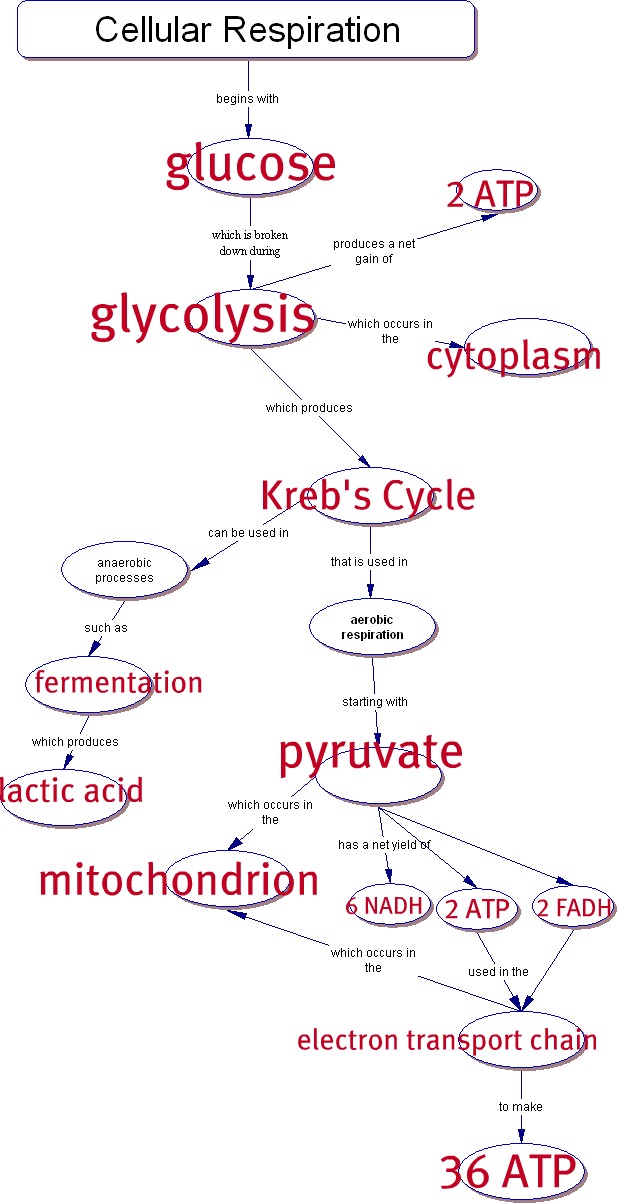
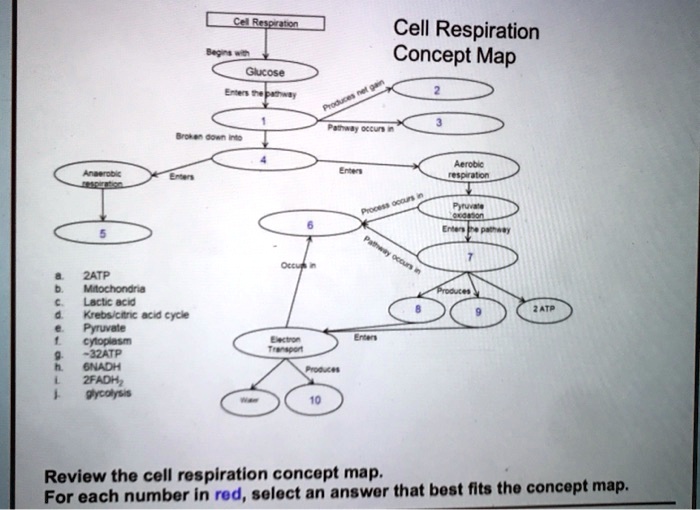
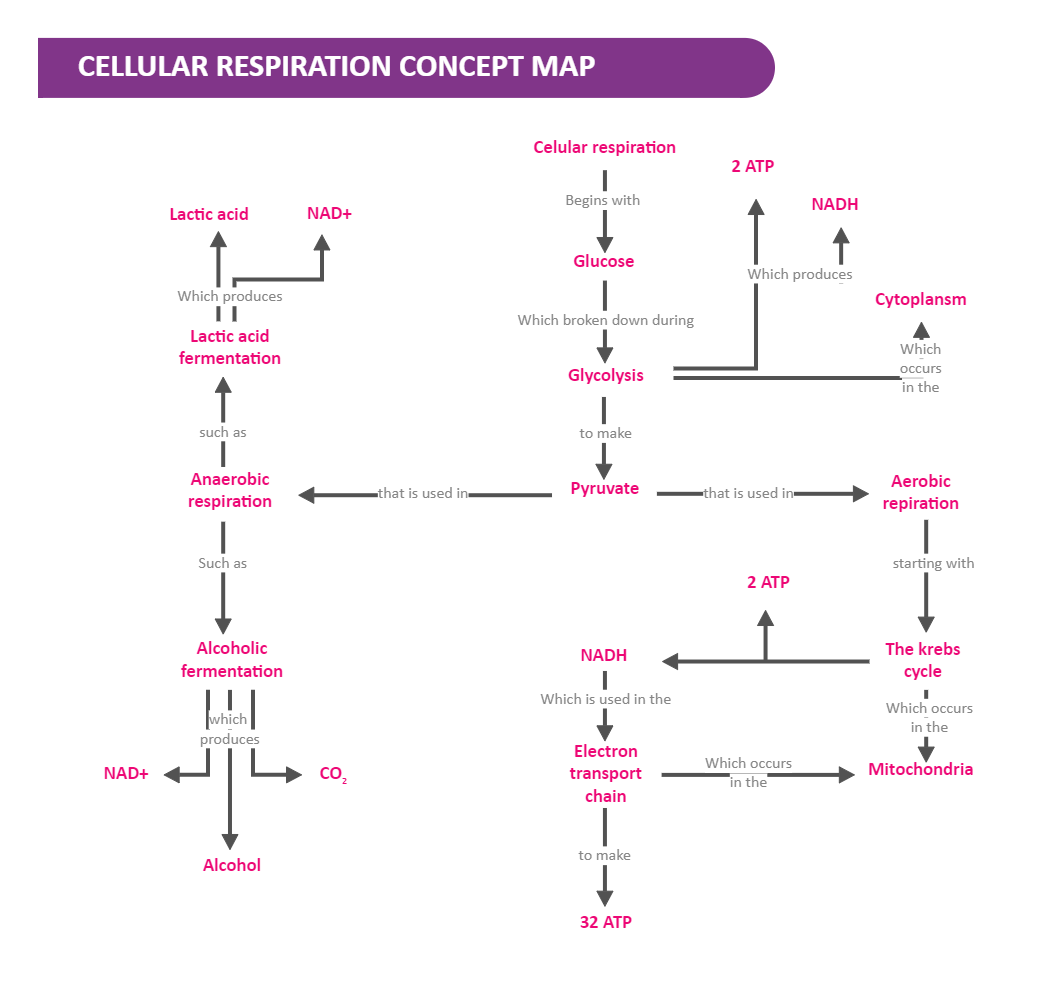
A concept map is a visual tool that illustrates the relationships between different concepts. In the context of cellular respiration, it helps to organize and connect the various stages, reactants, and products involved. By mapping out these relationships, we can gain a clearer understanding of how the entire process works.
C6H12O6 (Glucose) + 6O2 (Oxygen) → 6CO2 (Carbon Dioxide) + 6H2O (Water) + ATP (Energy)
Glycolysis: The initial breakdown of glucose into pyruvate.
Pyruvate Decarboxylation: Conversion of pyruvate to acetyl-CoA.
Krebs Cycle (Citric Acid Cycle): Oxidation of acetyl-CoA to produce ATP, NADH, and FADH2.
Electron Transport Chain (ETC) and Oxidative Phosphorylation: Use of NADH and FADH2 to generate a proton gradient, which drives ATP synthesis.
The concept map of cellular respiration begins with glucose, a six-carbon sugar. Glucose enters the cell and undergoes glycolysis in the cytoplasm. Glycolysis is the breakdown of glucose into two molecules of pyruvate, a three-carbon compound. This process also produces a small amount of ATP and NADH.
Energy-Investment Phase: Requires ATP to phosphorylate glucose and its intermediates.
Energy-Payoff Phase: Produces ATP and NADH as pyruvate is formed.
The net yield of glycolysis is 2 ATP, 2 NADH, and 2 pyruvate molecules. Under anaerobic conditions, pyruvate can be converted to lactate or ethanol through fermentation. However, under aerobic conditions, pyruvate enters the mitochondria for further processing.
Following glycolysis, pyruvate is transported into the mitochondria, where it undergoes oxidative decarboxylation. In this step, pyruvate is converted into acetyl-CoA (acetyl coenzyme A), a two-carbon molecule, with the release of carbon dioxide (CO2) and the formation of NADH.
The reaction is catalyzed by the pyruvate dehydrogenase complex, a multi-enzyme complex located in the mitochondrial matrix. Acetyl-CoA then enters the Krebs cycle.
The Krebs cycle, also known as the citric acid cycle or tricarboxylic acid (TCA) cycle, is a series of chemical reactions that extract energy from acetyl-CoA. This cycle occurs in the mitochondrial matrix and involves eight major steps. During the Krebs cycle, acetyl-CoA combines with oxaloacetate to form citrate, which then undergoes a series of transformations, releasing CO2, ATP, NADH, and FADH2.
Citrate Formation: Acetyl-CoA combines with oxaloacetate to form citrate.
CO2 Release: Two molecules of CO2 are released during the cycle.
ATP, NADH, and FADH2 Production: Energy carriers are generated.
Oxaloacetate Regeneration: Oxaloacetate is regenerated to continue the cycle.
For each molecule of acetyl-CoA that enters the Krebs cycle, the following products are generated: 1 ATP, 3 NADH, 1 FADH2, and 2 CO2. The NADH and FADH2 molecules then proceed to the electron transport chain.
The electron transport chain (ETC) is a series of protein complexes located in the inner mitochondrial membrane. These complexes accept electrons from NADH and FADH2, passing them along the chain in a series of redox reactions. As electrons move through the ETC, protons (H+) are pumped from the mitochondrial matrix into the intermembrane space, creating an electrochemical gradient.
Complex I (NADH dehydrogenase): Accepts electrons from NADH.
Complex II (Succinate dehydrogenase): Accepts electrons from FADH2.
Coenzyme Q (Ubiquinone): Carries electrons between complexes I/II and complex III.
Complex III (Cytochrome bc1 complex): Transfers electrons to cytochrome c.
Cytochrome c: Carries electrons to complex IV.
Complex IV (Cytochrome c oxidase): Transfers electrons to oxygen, forming water.
The final electron acceptor in the ETC is oxygen (O2). Oxygen accepts electrons and combines with protons to form water (H2O). This step is crucial because it allows the ETC to continue functioning. Without oxygen, the ETC would become backed up, and ATP production would cease.
The proton gradient generated by the ETC is used to drive ATP synthesis through a process called oxidative phosphorylation. ATP synthase, an enzyme complex located in the inner mitochondrial membrane, allows protons to flow back into the mitochondrial matrix, down their electrochemical gradient. This flow of protons provides the energy needed to phosphorylate ADP (adenosine diphosphate) to ATP.
Oxidative phosphorylation is highly efficient, producing the majority of ATP generated during cellular respiration. For each molecule of glucose, approximately 32-34 ATP molecules are produced through oxidative phosphorylation.
Glycolysis: Regulated by enzymes such as phosphofructokinase (PFK), which is inhibited by high levels of ATP and citrate.
Pyruvate Decarboxylation: Regulated by the pyruvate dehydrogenase complex, which is inhibited by high levels of ATP, acetyl-CoA, and NADH.
Krebs Cycle: Regulated by enzymes such as isocitrate dehydrogenase and α-ketoglutarate dehydrogenase, which are inhibited by high levels of ATP and NADH.
The rate of cellular respiration is also influenced by the availability of substrates such as glucose and oxygen. High levels of these substrates can increase the rate of ATP production.
What is the main purpose of cellular respiration? The main purpose of cellular respiration is to produce ATP, the primary energy currency of the cell.
Where does cellular respiration occur? Cellular respiration occurs in the cytoplasm (glycolysis) and mitochondria (pyruvate decarboxylation, Krebs cycle, and electron transport chain) of eukaryotic cells. In prokaryotic cells, it occurs in the cytoplasm and cell membrane.
What are the reactants and products of cellular respiration? The reactants are glucose and oxygen, and the products are carbon dioxide, water, and ATP.
How many ATP molecules are produced during cellular respiration? Approximately 32-34 ATP molecules are produced per molecule of glucose in eukaryotic cells.
Cellular respiration is essential for life, providing the energy needed for various cellular processes. Understanding the concept map of cellular respiration helps to appreciate the complexity and efficiency of this fundamental biological process.
In summary, cellular respiration involves several key stages: glycolysis, pyruvate decarboxylation, the Krebs cycle, and the electron transport chain. Each stage contributes to the production of ATP, the energy currency of the cell. By using a concept map, we can visualize the relationships between these stages and gain a deeper understanding of cellular respiration.
Cellular respiration is a multi-stage process that breaks down glucose to produce ATP.
Glycolysis occurs in the cytoplasm and produces pyruvate, ATP, and NADH.
Pyruvate is converted to acetyl-CoA, which enters the Krebs cycle.
The Krebs cycle produces ATP, NADH, FADH2, and CO2.
The electron transport chain uses NADH and FADH2 to generate a proton gradient, which drives ATP synthesis through oxidative phosphorylation.
Oxygen is the final electron acceptor in the ETC, forming water.
Cellular respiration is regulated to meet the cell’s energy demands.
By understanding these key concepts, you can better appreciate the importance of cellular respiration in sustaining life.